


WHAT JESUS SAID
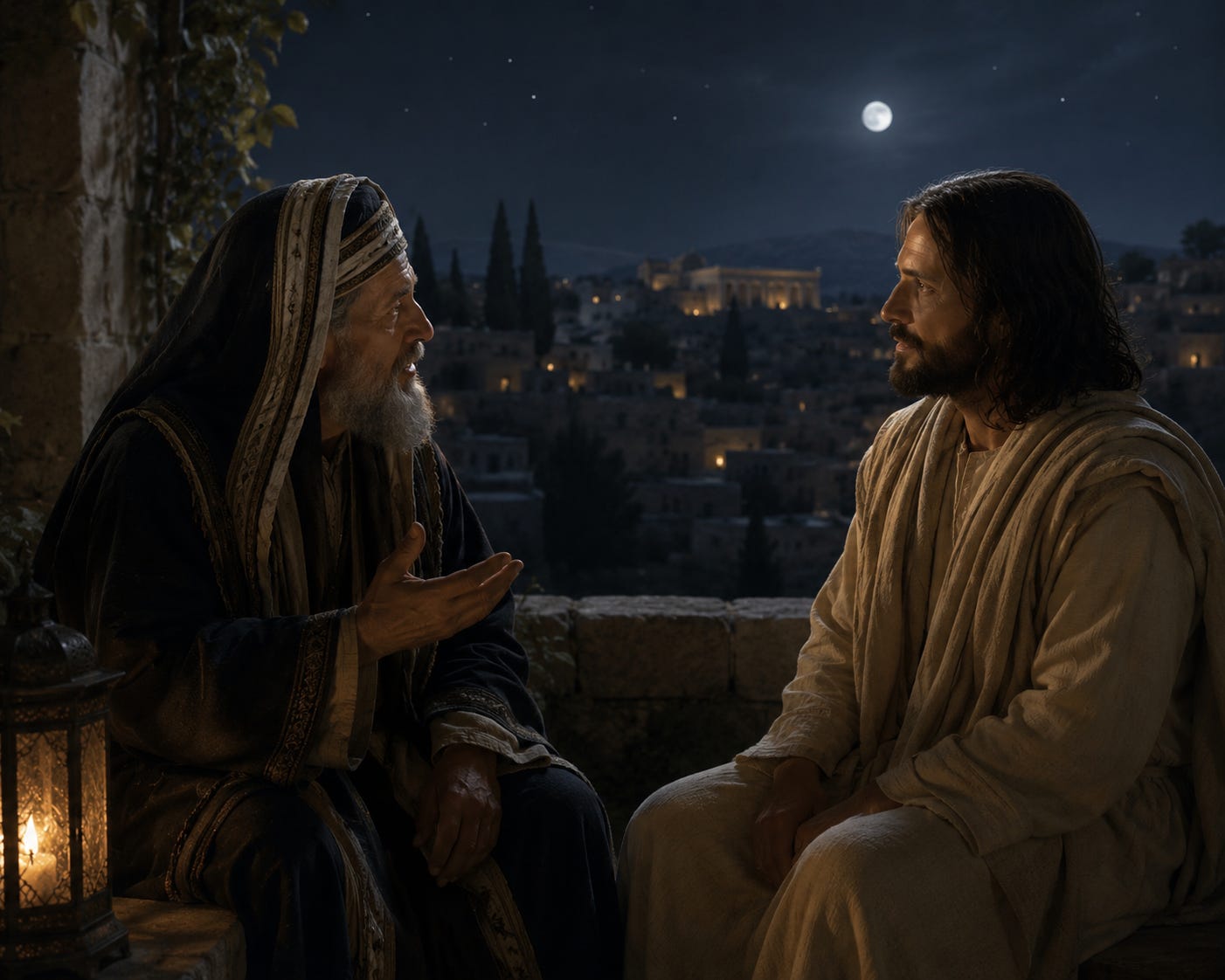
Read the conversation between Jesus and a Pharisee named Nicodemus in John 3:1-12. Concerned for his reputation, and not fully convinced that He was the awaited Messiah, Nicodemus secretly went by night to see the Man. Nicodemus calls the Lord “a teacher from God” and figures His miraculous signs wouldn’t be possible otherwise. Jesus responds with one of the most enigmatic statements:
“I tell you the truth, unless you are born again, you cannot see the Kingdom of God.”
Nicodemus had trouble imagining how a man could re-enter his mother to be born a second time. This prestigious Pharisee—who knew the Law inside and out and taught it to others—could not comprehend spiritual things. Jesus declares again:
“No one can enter the Kingdom of God without being born of water and the Spirit. Humans can only produce human life, but the Holy Spirit gives birth to spiritual life.”
The phrase “born of water” has led to centuries of baptism debates among high-minded scholars not unlike Nicodemus. For the sake of logical simplicity, let’s understand the context as Jesus addressing humanity coming through water in the womb. Obviously, He’s not speaking about the angels in heaven ministering to God day and night with no need for salvation to enter the Kingdom. Only human beings are born of water (of woman) and born again of the Spirit.
Before Nicodemus can show off the expert knowledge and reasoning skills he acquired from years of practicing Judaism, Jesus compares the born again experience to uncontrollable weather patterns. The Savior says:
“Don’t be surprised when I say, ‘You must be born again.’ The wind blows wherever it wants. Just as you can hear the wind but can’t tell where it comes from or where it is going, so you can’t explain how people are born of the Spirit.”
Again, the most educated among us have debated this passage and invented all sorts of doctrines to expound on the mystery of salvation. Those who can discern spiritual things know the Messiah is clarifying that the work, the power, the very moment of regeneration is far beyond the reach of sinful man’s wisdom and religious practices. In other words, only God can control the wind. When Nicodemus asked how this—being born again—was possible, Jesus calls him out for possessing all the credentials and mastery of an astute Rabbi while failing to discern the unbelief in his own heart.

REAL CHRISTIANS CAN DISERN SPIRITUAL THINGS
To be fair, Nicodemus approached Jesus before the Resurrection and received information that ultimately pointed to what would happen after His Ascension. The Law doesn’t specifically say the Messiah will “give His Spirit to His followers,” although this supernatural reality was prophesied in Ezekiel 36 and Jeremiah 31. Nicodemus’s training also didn’t prepare him to look for salvation in a nomad who would be tortured and executed only to rise from the dead three days later.
John 7:50-51 shows Nicodemus risking his reputation by defending the Lord’s right to be heard fully before passing judgment. This public discourse among prominent Jewish leaders is likely of greater significance and severity than most Gentiles will comprehend. By John 19:39-42, Nicodemus is present at the burial of Christ, and he did not come empty-handed! The Bible says Nicodemus brought 75 pounds of myrrh and aloes—only kings and highly honored figures were buried with these spices in Jewish tradition.
In common vernacular, Christians say Nicodemus “got saved.” But Jesus did not use this phrase to describe how one enters the Kingdom—He said we must be born again. Scripture doesn’t record Nicodemus repeating a “sinner’s prayer” or delivering grandiose doctrinal statements from a pulpit. Instead, the evidence of his belief in Christ is marked by transformation. This prominent teacher of the Law who started seeking in obscurity eventually made a faith declaration before the whole world.
If you are not born again, you will not enter the Kingdom, and you cannot discern spiritual things. Just what are these “spiritual things” anyway? For our context, it primarily refers to the substance of salvation—which cannot be attained through natural means of ritualism, intellectual pursuits, or economic status. In 1 Corinthians 2:6-16, the apostle Paul distinguishes between the “wisdom of this age” that will soon die and the “mystery of God” that’s eternally revealed in His children, namely Gentiles (see Eph. 3:1-12; Col. 1:24-28). Speaking of born again believers, Paul declares in 1 Cor. 2:12-15:
“And we have received God’s Spirit, so we can know the wonderful things God has freely given us. When we tell you these things…we speak words given to us by the Spirit, using the Spirit’s words to explain spiritual truth. But people who aren’t spiritual can’t receive these truths from God’s spirit…only those who are spiritual can understand what the Spirit means. Those who are spiritual can evaluate all things…”
Salvation is not a matter of how often we attend church (there are false converts aplenty in every service) or even if we read the whole Bible in a year. Rather, Paul is harkening back to the conversation between Christ and Nicodemus, urging us to earnestly seek that which only the wisdom and power of God can provide.
Salvation is a spiritual thing.
HOW DO I KNOW I’M A REAL CHRISTIAN?
If you’re still pondering this question, or you’re stuck like Nicodemus asking, “How is this possible?”—it may be best to clarify what a Christian is not. Contrary to popular belief, real Christians are not “nice” or “good people.”
Consider the “nice” Christian who patiently listens to other’s problems…but they’re a gossip, eaten up with bitterness, jealousy, and unforgiveness. Or, do you know a Christian business owner who plans all sorts of church activities on weekends…but treats their employees like trash Monday through Friday? Have you met a Christian who lovingly condemns homosexuality…but they have no conviction about sleeping with their boy/girlfriend or viewing pornography? The polite Christians memorize Matthew 7:1-3…but they don’t love anyone enough to warn them about hell.
It’s easy to label helpful, church mouse, non-judgmental Christians as “nice” or “good.” After all, they do the right things, show up at the right time, and know exactly when to encourage you to “give it to God.” Instead of talking about repentance or confronting sin, “nice” Christians take every opportunity to remind us “nobody’s perfect.” They prove it is entirely possible to look “good” on the outside while inwardly rebelling against God. “Nice” Christians are usually the biggest hypocrites. These are not “good people.” These are people who cannot discern spiritual things.
Just like the devil, humans are prone to manipulation, intimidation, selfish-ambition, impure motives, and insincere intentions. Every one of us are capable of deceiving and being deceived. We’ve all smiled in a person’s face while secretly despising them. We are not inherently good; we are inherently wicked. We are born with a sinful nature as sons of Adam and daughters of Eve. Only the power of the Holy Spirit and the blood of Jesus can cure this eternally fatal disease. So, when a “nice” Christian feeds you that line, “God knows my heart; He knows your heart,” show them Jeremiah 17:9-10:
“‘The human heart is the most deceitful of all things, and desperately wicked. Who really knows how bad it is? But I, the Lord, search all hearts and examine secret motives.’”
Apart from Christ, no one can judge good and evil—that is good and evil from God’s holy, righteous, and perfect perspective. Knowing how to spot a real Christian, requires the supernatural ability to discern spiritual things. This does not come by earning a seminary degree, attending church every time the doors are open, donating large sums of money, or dressing modestly. Of course, salvation in Christ should lead to good works and produce good fruit (character), but outward behaviors alone are not evidence of transformation. What distinguishes true believers from the nominal, the fake, and the world is found in the conversation between Jesus and Nicodemus: